The Transactional Identity
Our environment and society plays a major role in the opinions, lives, and choices that we make on a day to day basis even when we may not consciously realise this. Diogène ou la Lucidité - courtesy of the Stephen Bulger Gallery - explores the theme of solidarity as a byproduct of mentality and action. A man can be seen walking through darkness as he holds a source of light tied to a disorganised heap resembling tumbleweed, what he represents is something that resonates with my own experiences of isolation. The individual’s actions come at the unseen cost of society’s judgment, creating a conflict between personal ideals and society’s verdict as he grows closer to isolation.
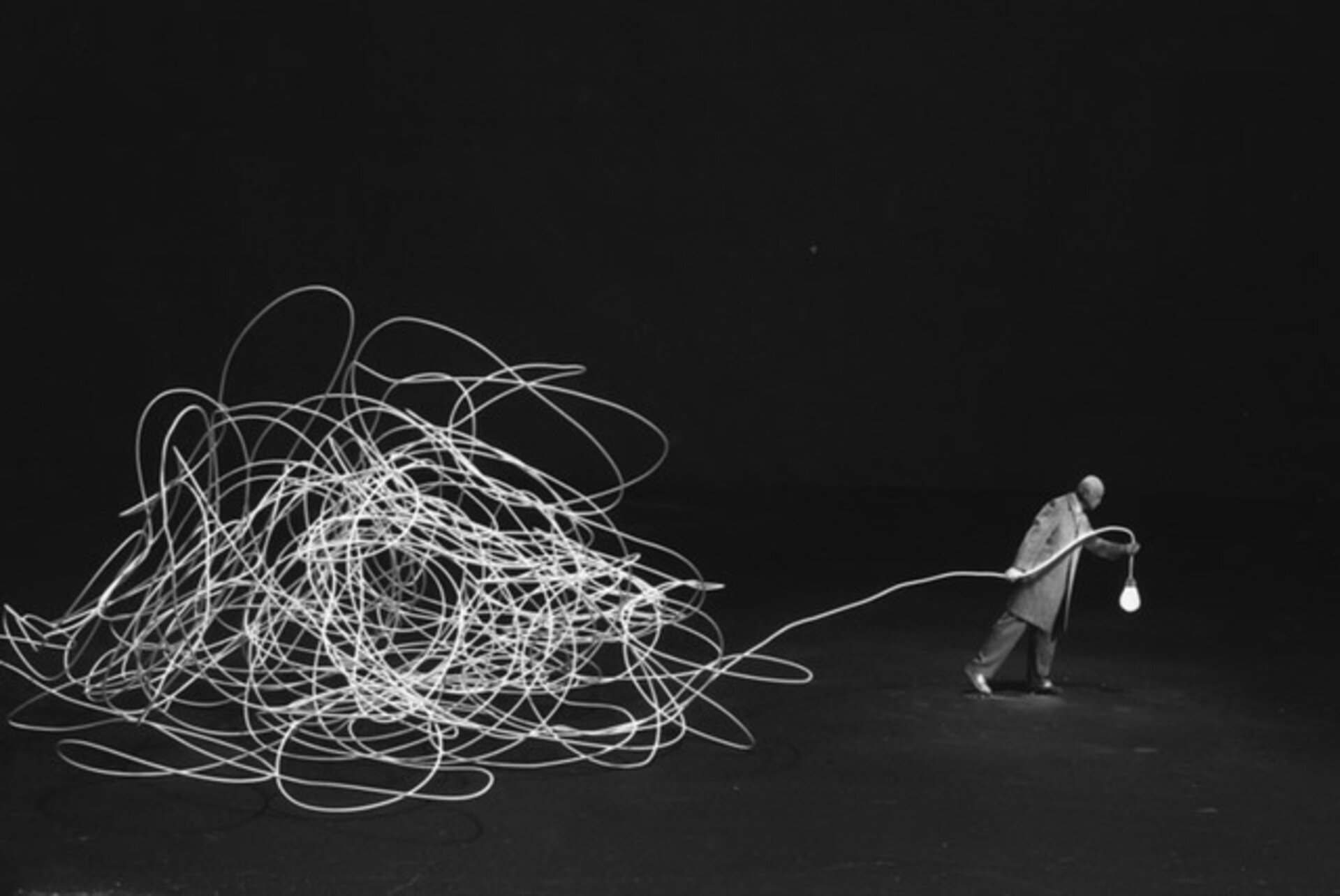
Diogenes, a philosopher whose life fascinated society because of how unconventional it was, did not value conformity in the way many of his contemporaries in Athens did. He rejected the idea that it was the only path to happiness. Instead, he lived in a barrel on the street alongside dogs for much of his life, and mocked those who criticized him while claiming that, despite his poverty, he lived better than they ever would. His commitment to self-expression challenged the boundaries of conformity and freedom, and was extraordinary enough to attract the attention of Alexander the Great. The man in the visual traverses darkness while carrying the light, an allusion to Diogenes himself, who was said to carry a lantern in broad daylight while claiming to search for an honest man. Many people’s reactions to his life follow a similar pattern: confusion as to why he refused a more comfortable existence, even if it meant compromising his ideals.
I found myself in that figure, although I initially struggled to understand why. Rebellion against the void is more burdensome for the man in the image than submission would be, just as life would have been easier for Diogenes had he chosen not to live in such a humiliating circumstance. In the same vein, my own life may have been easier had I blindly accepted the ideals, norms, and attitudes that were imposed on me or surrounded me throughout my childhood. Furthermore, to live in blissful ignorance sounds appealing, so why insist on being myself, or thinking for myself, instead of following whatever society dictates? After all, it is unreasonable to go to such lengths in order to preserve one’s sense of self by putting one’s desires on a pedestal when it provides no profit beyond a sense of fleeting solace.
The reality, however, is that this complete detachment from my will would entail having to change who I am, for a person is nothing more than a mosaic of their emotions, their loved ones, and their decisions. The man in the image is inseparable from that light. He holds onto it knowing that the tangled burden behind him will follow, but also knowing that without it he could no longer remain the same person. Without the light, he would disappear into the darkness, assimilating into it and becoming indistinguishable. This isn’t to say that, the other extremity, which is the complete and undiscretionary indulgence of desire and one’s own will, is the key to self-fulfillment. Furthermore, this level of indulgence can result in emotional desensitisation and isolation, and just like the pedestalization of desire, provides no profit either. Diogenes freed himself from the burdens of societal expectations and pressure, but it was not without cost, as he lived a life devoid of real relationships or purpose. The freedom that Diogenes envisioned through his ascetic lifestyle was only achievable if he lived a life of true contentment with the prison he had constructed for himself, which begs the question as to why he’d even bother to break his chains only to willingly tie himself with more. Diogenes may have found fulfillment in his own way, but it could also very well be that his life was spent in a fruitless endeavour.
Diogène ou la Lucidité presents two paths through the experience of one man carrying a source of light that serves as a double-edged sword: one edge grants him vision, while the other drags behind him. The image’s elements and allusions present the tension between conforming to what we are told is normal and remaining faithful to the ideals we hold within ourselves. As I reflected on the image, I found elements of myself in the man with the lantern. It made me realize that this tension is not as isolating as I once believed, but something many people quietly experience as they navigate the space between comfort and freedom.